

 ZH
ZH
 EN
EN
Lessons from the Hong Kong Fire: Building a Fire Prevention System for High rise Buildings with a Focus on Prevention
Unlike typical building fires, in the early stages of the fire, the Hongfu Garden fire mainly spread from the outside. Combustible scaffolding and other materials caught fire and surrounded the building, forming a three-dimensional fire that quickly entered the interior through windows. The core reason for the rapid expansion of the fire caused by is the "chimney effect" present in the architectural design.
Hongfu Garden adopts the popular "new cross shaped" design of the 1980s, with a large courtyard running through the top and bottom in the middle, originally designed for ventilation and lighting. At that time, no fire separation was set up, and the courtyard instantly turned into a "fire chimney" during the fire, with hot smoke and flames rapidly rising up along the shaft, causing each floor to be lost one after another. What's even more serious is that many old residential buildings have doors and windows that don't meet today's fire safety standards. Aluminum alloy windows will quickly soften and lose their structural strength in an environment of 600 ℃ -800 ℃, while ordinary glass may burst at around 200 ℃ -300 ℃. These non fireproof building materials become a "weak link" in a fire, allowing flames to "break through the window".
Fire prevention regulations are constantly being upgraded, but a large number of old buildings are still stuck in the "low configuration era"
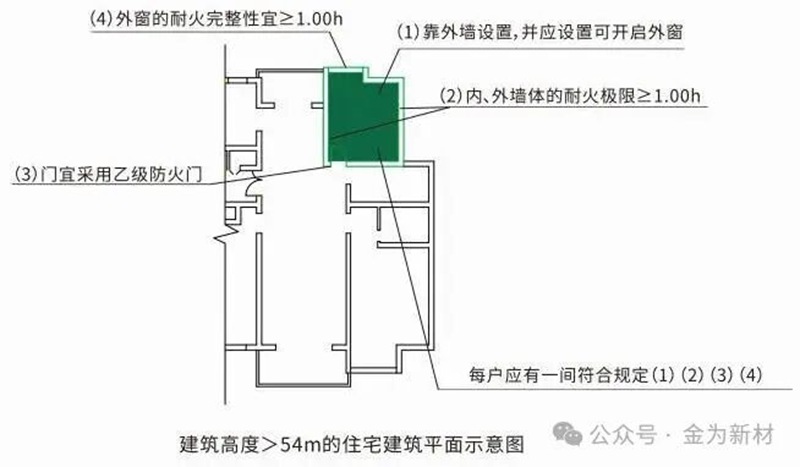
. Since its release, China's "Code for Fire Protection Design of Buildings" has been revised multiple times. The 2018 version has put forward clear requirements for high-rise residential buildings: a fireproof partition wall with a fire resistance limit of not less than 2 hours should be installed between the equipment room and the refuge area, and the pipe well door should not directly open to the refuge area. Each household in residential buildings over 54 meters should have a refuge room, and its exterior walls, doors and windows should have a fire resistance performance of more than 1 hour.
These specifications are iteratively upgraded with new fire prevention concepts in each version. However, old buildings like Hongfu Garden, built in the last century, were not included in current standards at the beginning of their design, resulting in inherent deficiencies. According to statistics, about 30% of the existing urban buildings in China were built before 2000, and a large number of residential buildings have not been equipped with fire-resistant windows or doors, nor have they undergone courtyard fire prevention renovations.
How can we make up for the fire safety shortcomings of old buildings from "compliance" to "safety equivalence"? The Hongfu Garden fire has revealed a real problem: relying solely on "complying with current regulations" cannot cope with complex fire risks. For old buildings, the concept of "safety equivalence" should be promoted - that is, through later renovation, their fire resistance performance should not be lower than that of new buildings. Similar renovations have been promoted in some cities. For example, Shanghai has carried out fire safety renovations on over 1400 old high-rise residential buildings between 2021 and 2023, with a focus on updating doors, windows, pipeline wells, and fire exits. As a company deeply involved in providing systematic solutions for building fire separation, we are well aware that safe construction not only depends on the formulation of regulations, but also on material selection and construction implementation. We inject a solid safety gene into every building by developing high-performance fire separation system solutions.
Learn from the lessons of the Hong Kong fire, promote building fire prevention from "compliance" to "safety equivalence", and inject hard requirements such as "fire resistance limit", "fire integrity", and "smoke separation" into every detail of the building from the drawings, becoming the conscious and responsible of all industry practitioners.